Undergarment foundations for transparent mesh
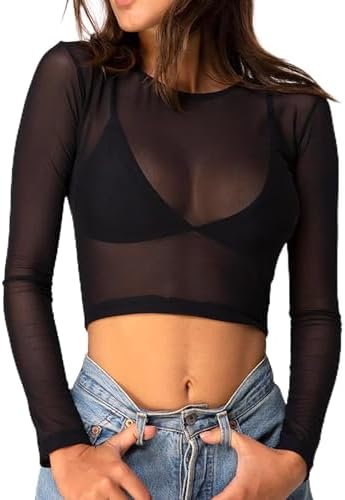
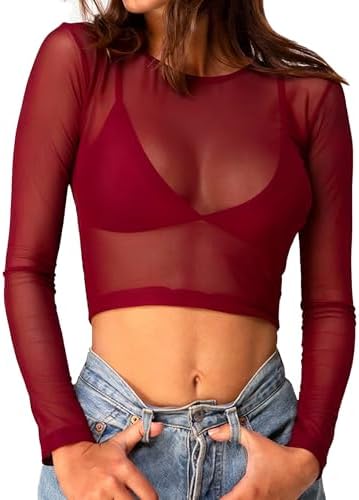
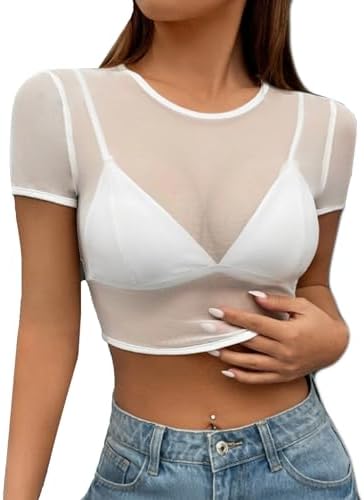
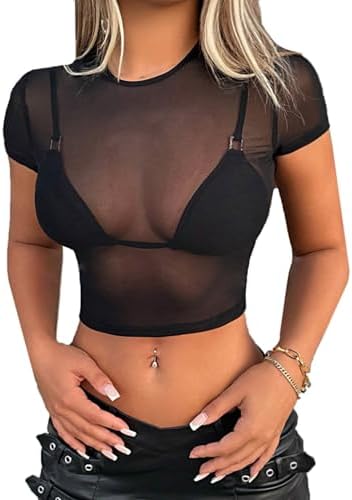
Fine mesh allows base layers to remain visible, which makes the choice of foundational pieces practical. Plain triangle bralettes, molded seamless cups, and smooth bandeau bands create a flat profile beneath fine tulle. High-apex bras with minimal lace trim prevent friction against thin netting. Dark undergarments anchor black mesh, while nude tones reduce visual contrast beneath light fabrics.
Camisoles with straight necklines add front torso coverage under looser sheer shirts. Wide straps sit flat on shoulders without bunching the outer netting. For cropped cuts, longline bras provide a structured edge that stops right where the sheer hem begins, avoiding awkward gaps or fabric overlaps.
Understanding stretch at the hem
Most transparent tops use nylon or polyester blends with five to fifteen percent spandex. The knit structure yields crosswise elasticity across the ribs and waist. But the lower hemline rarely functions as an elastic band unless finished with silicone tape or a fold-over elastic binding. It drapes rather than grips.
A raw-cut or narrow overlock stitch at the bottom hem will sit lightly against the skin. If a cropped shirt lacks an encased elastic band, it tends to ride up during normal arm movement. Sizing up reduces this pull across the chest, helping the hem stay level across the lower ribs.
Evaluating long sleeve and crop cuts
Long sleeve mesh tops require adequate armhole clearance to prevent pulling at the shoulders. A tight sleeve tugs the front neckline downward whenever you reach forward. Look at the wrist finish. A bound cuff holds the sleeve in place, whereas a raw edge allows push-up styling without tight pressure on the forearm.
Cropped patterns end anywhere between the underbust and natural waistline. Body proportions dictate where the cut lands. Checking the total center-back length in garment specifications gives the clearest measurement of torso coverage before choosing a matching high-waisted bottom piece.
Spotting lined panels in catalogue images
Catalogues display garments on mannequins and live models to show transparency differences. Look closely at the chest area for shadow lines. A fully lined section appears solid and reflects light differently than single-ply netting. Double layers create a flat, matte appearance across the bust, hiding flesh tones underneath entirely.
Inspect the interior edge lines around the armholes and neckline. A lined panel produces a visible internal seam line and a thicker edge fold. If the model skin tone remains partially visible across the bust line, the piece is unlined mesh rather than padded or backed with opaque tricot knit.
Care instructions for fine netting fabrics
Mesh knits catch easily on jewelry, zipper teeth, and rough surfaces. Wash these pieces inside a mesh garment bag using cold water on a gentle cycle. Standard agitation can overstretch delicate spandex fibers, leading to ripples along the side seams. Mild liquid detergent prevents fabric stiffening over repeated cycles.
Air dry sheer tops on flat racks away from direct heat sources. Tumble dryers break down elastic filaments, causing the shirt to lose recovery over time. Steaming removes packing wrinkles safely, whereas a hot iron base plate will melt synthetic nylon mesh on contact.
Check the inside seam color in catalogue images to determine if an opaque panel is fully lined or single-ply mesh.